
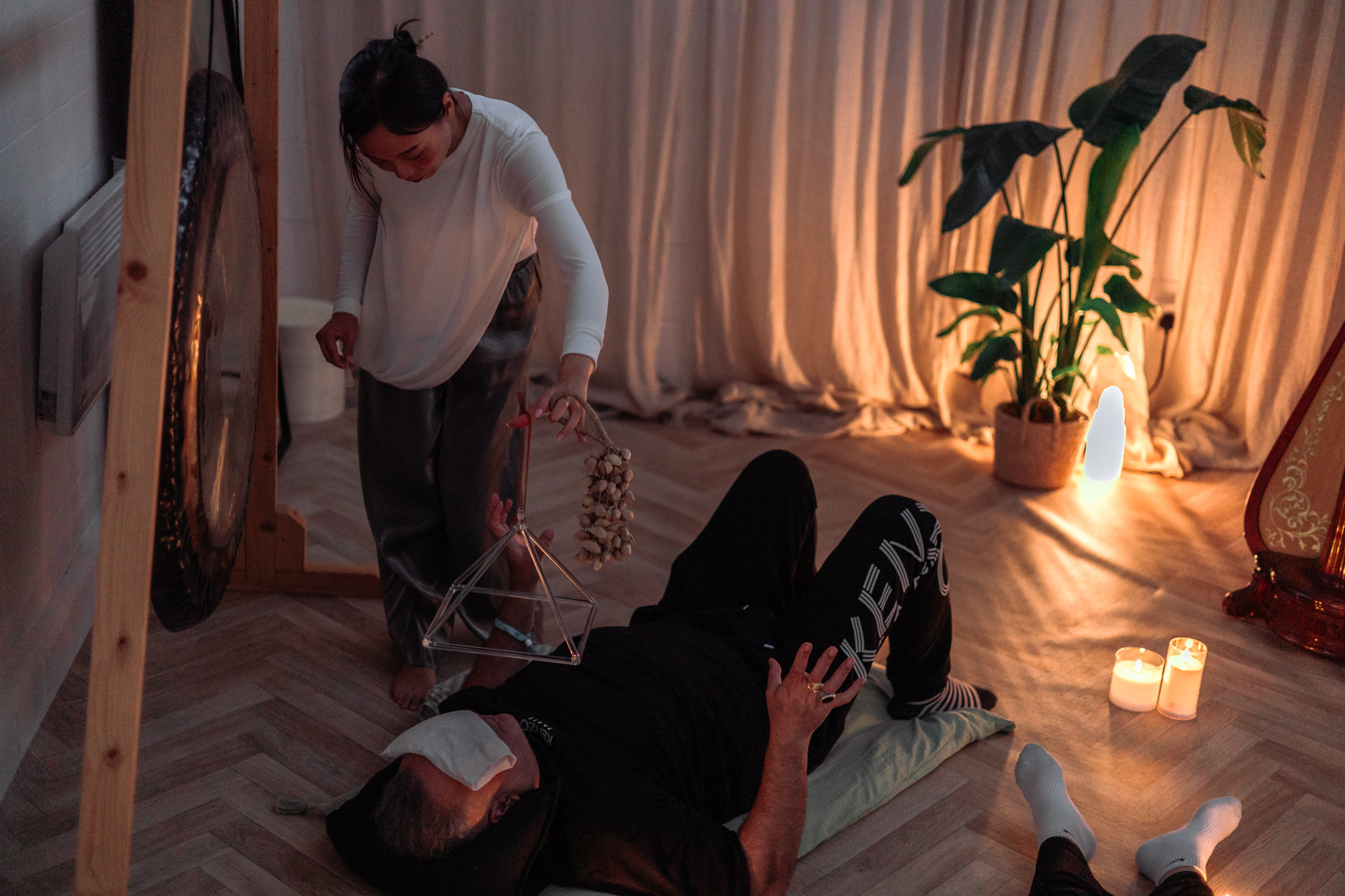
A sound bath is where you lie down in front of a set of sound healing instruments and the sound healing practitioner will perform a journey of sound and vibrations. While you’re fully relaxed listening to the sound, it is not about “doing it right” or achieving a perfectly quiet mind. It is an experience of being immersed in vibration, where the body and nervous system respond in their own natural way.
In my work as a sound healer and teacher, I often tell clients: you don’t come to a sound bath to perform meditation. You come to receive sound.
Every person’s experience is different, but there are common patterns I consistently observe across hospital settings, hotels, private sessions, and group sound baths. If you’d like personalised support, explore my London sound healing sessions, which combine singing bowls, gongs and Reiki in a private setting.
What People Commonly Experience During a Sound Bath
Physical Sensations in the Body
One of the first things people notice is that the body starts to respond before the mind fully understands what is happening.
Common physical experiences include:
- Tingling in the hands, feet, or face
- Warmth spreading through the body, often experienced as energising
- A cooling or cold sensation, often linked to deep release of stagnant energy
- Heaviness in the limbs, as the body begins to drop into rest
- A sense of floating or being “held” by the sound
These sensations are not random. In my view, vibration interacts with the body’s internal rhythm and helps the nervous system shift out of survival mode into a more restorative state.
Brainwave Changes and the Theta State
It is very common for people to drift into a theta-brainwave state during a sound bath.
This is where:
- The body may be deeply relaxed
- Breathing slows down
- The mind becomes less linear
- People may snore while still remaining vaguely aware of the sound
I often explain to clients that you do not need to “empty the mind” to benefit. In fact, the mind can still be active, and the sound will still guide the nervous system into relaxation.
Snoring is something many people worry about beforehand, especially the idea of disturbing others. In reality, it is often a sign of deep release, not disruption. I take it as a sign of success, that the sound and vibrations are achieving the result of deep state.
Emotional Responses
Emotionally, sound baths can be subtle or unexpectedly powerful.
What I frequently witness includes:
- A deep sense of peace and calm
- Emotional softening or quiet release
- Feeling less stressed or internally “unclenched”
- A noticeable sense of relief after the session
Many clients describe it as feeling “lighter” afterwards, both physically and emotionally.
Visuals, Colours, and Inner Experiences
Some participants report seeing colours, light patterns, or internal imagery. I never guide people toward expecting visions, but they can arise naturally when the nervous system shifts into a more receptive state. From my perspective, this is part of how awareness expands when the analytical mind becomes less dominant.
What Sound Is Doing in the Body and Mind
My approach to sound healing is rooted in vibration and entrainment.
I believe sound works in several ways at once:
- It harmonises areas of internal imbalance through vibration
- It helps entrain brainwaves into slower, more restorative states
- It creates a sensory environment that allows the nervous system to unwind
- It supports awareness to expand beyond habitual thinking patterns
In simple terms, sound does not force change. It creates conditions for the body to reorganise itself.
This is why I often describe my approach as “less is more.” The vibration does the work when the system is ready to receive it.
My Approach to Sound Baths
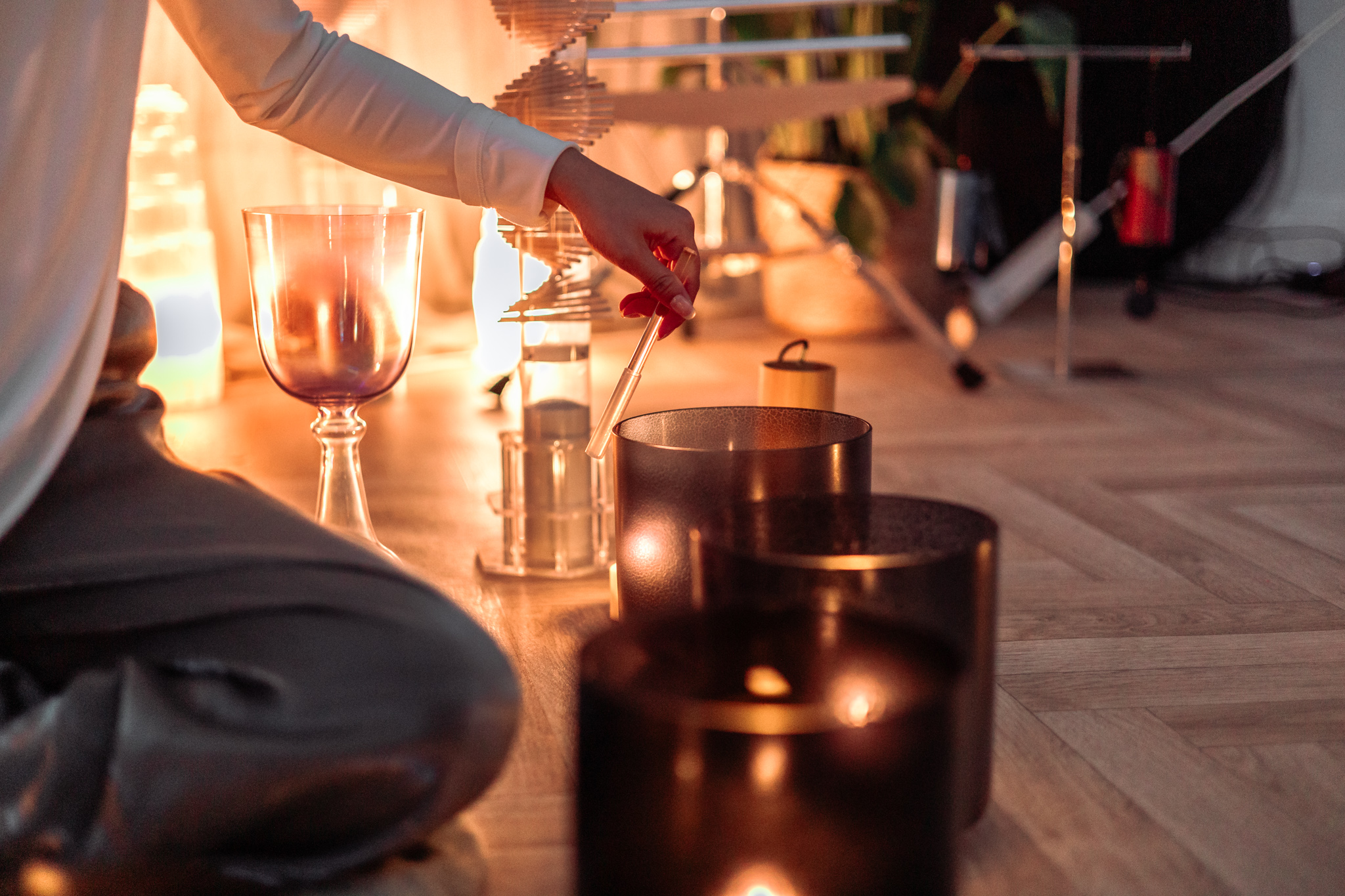
I specialise in singing bowls and work intuitively with a carefully chosen soundscape.
Each instrument has a different role in the journey:
- Singing bowls: grounding, balancing, and stabilising the energy field
- Gong: rich in overtones and harmonics, creating depth and expansion
- Conch shell: raw and powerful vibration that cuts through stagnation
- Drum: rhythmic, shamanic energy that can shift awareness into trance states
- Chimes and small instruments: gentle integration into the nature and soft grounding
I do not believe sound baths should be overwhelming. My style is intentionally calming and spacious, allowing the body to absorb sound rather than chase it.
How a Typical Sound Bath Unfolds
Opening the Space
A session may begin with intention setting, a short meditation, or guided relaxation, depending on the group and setting.
The goal is always the same: to help people arrive fully into their body and the present moment.
The Sound Journey
The structure is intuitive but generally follows a natural arc:
- Singing bowls often begin the session, creating grounding and coherence
- The soundscape gradually expands into deeper layers, often including gong work
- Moments of silence are intentionally included and are just as important as sound
- Flow chimes, bowls, or softer instruments support transitions
- Rainsticks, shakers, and lighter textures often appear toward the end to gently guide integration
A typical sound journey lasts around 45 minutes within a 1-hour session.
What I Observe as a Practitioner
As a facilitator, I am not just “playing instruments.” I am continuously observing:
- Breath patterns in the room
- Subtle movements or shifts in posture
- Energetic changes in collective state
- Moments where the room needs more space or more support
No two sessions are ever the same, even when the structure looks similar on paper.

Closing the Session
I always bring people back gently and slowly.
The closing includes:
- Gradual return to awareness of the body
- Time for stillness before movement
- An invitation to express gratitude internally
I never rush this part. Integration is just as important as the sound journey itself.
Who Comes to Sound Baths
In my experience, sound baths attract people who are not necessarily defined by demographics, but by states of being. Many are experiencing:
- Burnout from work or caregiving
- High levels of stress or emotional pressure
- Mental fatigue and nervous system overload
- A need for deep rest or energetic reset
I work across many environments, from hospitals to luxury hotels, with residents, staff, and members. What unites them is not their background, but their need to feel lighter in themselves.
Returning clients often show me something very simple but powerful: they arrive, lie down, and immediately put their blanket over themselves. The body already remembers what to do.
What You Can Expect After a Sound Bath
The effects of sound healing are often immediate, but also continue unfolding after the session.
Clients frequently report:
- Feeling calmer and less stressed
- A sense of physical lightness
- Increased energy or clarity the next day
- Subtle emotional processing in the hours or days after
From my experience, sound healing is not always an instant transformation. It is often an integration process that continues beyond the session itself.
Final Reflection
A sound bath is not about escaping reality or achieving a perfect meditative state.
It is about allowing vibration to reorganise how the body and mind are holding stress, so that something more balanced can naturally emerge. Each person experiences it differently, but the underlying intention is always the same: to support the system in returning to harmony in its own way, in its own time.